

This is the first post in a series about tools I’ve been building as part of the Personal Finance for Educators project. Each tool has come from puzzling over a specific personal finance for educators question. Since this is the first post in the series, I want to make a brief note on my motivation.
Why I’m Building These With AI
These tools are built using generative AI — specifically Claude.ai. I’m not a professional developer, and I wouldn’t be able to build these without it. You might have some mixed feelings about the use of AI in education (I certainly do) but this is a very different use that I find compelling because it doesn't just enable someone like me — a well-intended nerd with no formal development background — to build things. It fundamentally changes what's worth building.
There are three things in particular that I want to highlight:
Specific in focus. AI makes it practical to build a tool that does exactly one thing for exactly one person in exactly one situation. The salary analyzer isn’t trying to serve every use case — it’s trying to answer a specific question that Wisconsin educators actually face. A general-purpose tool built for a mass market wouldn’t go this narrow.
Local and private. These tools run entirely in your browser. Nothing is stored or shared. Your data, your district comparisons, your financial situation are sensitive. That’s a deliberate choice, and it’s only practical because the processing happens on your device.
Non-monetizable by design. There’s no business model for a free WRS retirement estimator with no ads and no upsell to a financial product. No developer is going to build that. Generative AI makes the cost of creation low enough that the absence of a business model doesn’t matter.
That’s the philosophy behind this series and it aligns well with the philosophy of the project. Each tool starts with a real question, and exists only because it’s useful — not because it’s profitable.
The Transparent Salary Problem
This tool came out of a simple question:
What is a reasonable salary for a teaching position at a given district in Wisconsin?
My first instinct was to find the salary schedule for that district. Salary schedules used to be straightforward public documents — a grid showing exactly what a teacher earns at each combination of experience and education level. Increasingly, that’s not what I find.
Based on my own experience, confirmed by others in the field:
Salary schedules are harder to find on public websites than they used to be.
Districts have introduced structures like “Total Compensation” or Tiers that make it unclear what a raise from year to year actually looks like.
Some districts describe only a process for determining pay, with vague language about how initial salary is calculated.
Handbooks — which sometimes contain salary information — are also harder to locate online. (If you’re willing to share examples, I’d love to see them.)
None of this is necessarily intentional opacity. I’m not saying there is a coordinated effort by administrators to hide this information. But the practical effect is that a teacher evaluating a job offer, or trying to understand where their salary stands, has fewer clear answers than they should.
What the Public Data Offers — and Where It Falls Short
A different approach to answer the question is to start from the available public data. Wisconsin does make salary data publicly available through the DPI. Two sources in particular:
The DPI Public Teacher Salary Report provides annual, school-level data including salary ranges, fringe benefits, and years of experience.
The DPI Public All Staff Report goes deeper — individual staff members, specific assignments, actual salaries. It’s the most granular public data available.
The Teacher Salary Report is useful context but too general to answer the question of what a specific position should pay.
The All Staff Report is more useful, but working with it directly presents two problems. First, it’s genuinely overwhelming to someone who isn’t a frequent user of spreadsheets. The raw data isn’t designed for someone trying to answer a focused question. Second, that data lists individual names, which gives me pause. This is public data, and I’m not suggesting it shouldn’t be. But I’d rather focus on the numbers than on the people behind them. It’s too easy to start devaluing people for decisions about salary that they didn’t make. Teachers didn’t design the compensation system they work within. The goal here is to use data to understand and improve that system — not to scrutinize individuals.
A Note Before You Dig In
These tools are in active development. They’re designed to help you explore questions and estimate possibilities — not to replace professional financial advice or serve as the final word on any decision. If you find something that isn’t working as expected, please let me know.
The Tool
That’s what led me to build the Wisconsin Teacher Salary Analyzer.
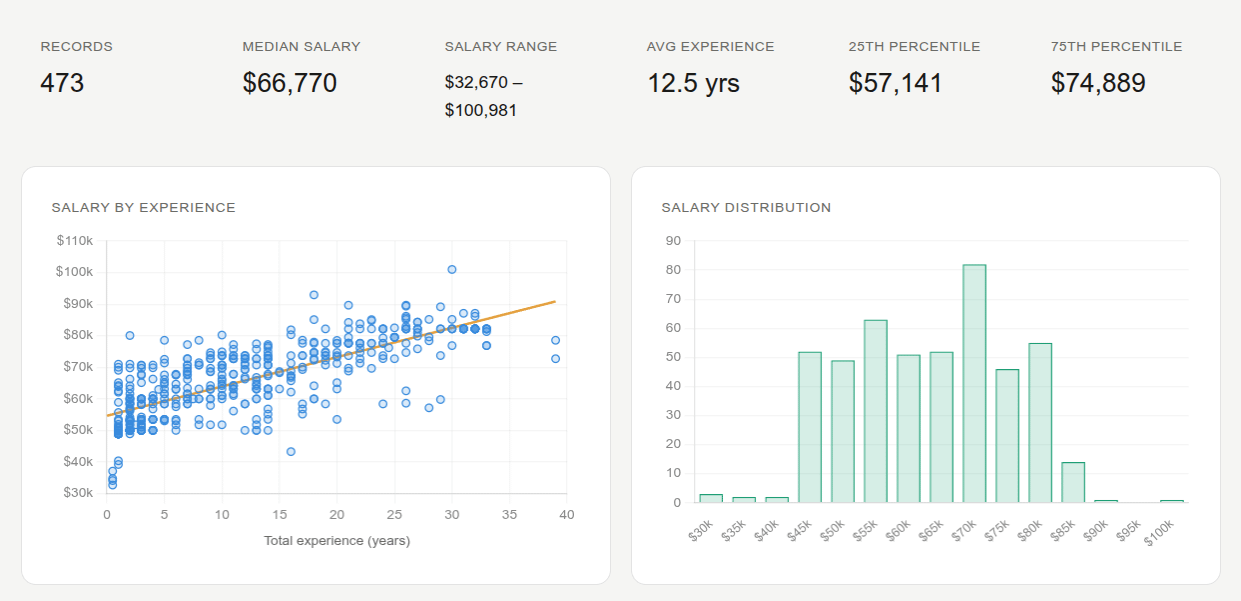
It lets you download the public DPI data, analyze salary ranges for any Wisconsin district, filter out outliers, estimate earnings based on years of experience, and compare across multiple districts — without names, without raw data overwhelm, and without needing to know anything about spreadsheets.
If you’re a teacher evaluating a job offer, curious how your district compares to neighboring ones, or just trying to understand what the data actually says about educator pay in Wisconsin — this is built for you.
Try It — and Tell Me What You Think
Try the Wisconsin Teacher Salary Analyzer →
This tool is free, runs in your browser, and requires no account or login.
If you use it, I’d genuinely love to hear what you think. Does it answer the question you brought to it? Is something confusing or not working as expected? Are there features that would make it more useful?
Feedback — positive, critical, or just a report that something broke — helps make these tools better for everyone. You can reach me through josh@personalfinanceforeducators.com or leave a comment below.