

In one of my periodic searches for resources to support educators, I learned about a program that I think all preservice teachers in Wisconsin should know about. It’s called the Teacher Loan Program (TLP), and it’s run by the Wisconsin Higher Educational Aids Board (HEAB). HEAB runs several financial aid programs for residents of Wisconsin that are worth checking out to see if you qualify. TLP was specifically created to support folks pursuing a career in teaching. If you’re studying to become a teacher in Wisconsin and meet the criteria, it can provide up to $30,000 toward your degree, and forgive it entirely if you end up teaching in the right place. So far, all of the faculty and future teachers I have shared information with have never heard of the program. This post aims to discuss what TLP is, who qualifies, and the opportunities it can create for folks who teach in an eligible district.
What is TLP?
TLP is a relatively new program. It was created by Wisconsin Act 55 in 2015 with a follow-up act later that same year refining some of the details around eligible work locations. The goal of the program is to incentivize teaching in specific areas of Wisconsin.
TLP works by giving loans to Wisconsin resident undergrads working toward teacher licensure. The money is a loan that has the potential to be forgiven in pieces if you teach in the right place.
Who’s eligible: Wisconsin residents, sophomores through seniors, enrolled at least half-time at a participating UW System school or a nonprofit private college in Wisconsin.
GPA requirement: 3.0 or higher on a 4.0 scale
How much: Students can receive up to $10,000 per year (max $30,000 total)
To be eligible for a loan, you have to be licensed in a discipline the U.S. Department of Education has identified as a teacher shortage area for Wisconsin. As of right now (September 2026), that includes:
Standard Disciplines: English as a Second Language, Bilingual Education, Foreign Languages, Mathematics, Music, Reading, Sciences, Library Media
Special Education: Cognitive Disabilities, Cross Categorical, Deaf and Hard of Hearing, Early Childhood-Special Education, Emotional/Behavioral Disorders, Learning Disabilities, School Speech and Language Disabilities, Visual Disabilities
Career and Technical Education: Agriculture, Business Education, Family and Consumer Education, Marketing Education, Technology Education
This list changes from year to year, so check the current shortage-area list before you count on a specific discipline qualifying.
Where you have to teach
In order to qualify for loan forgiveness, you have to teach full-time after graduation in one of the following places:
The city of Milwaukee. Anywhere within city limits qualifies, not just a specific county.
A county that the statute defines as “rural.” HEAB publishes a specific list and map of which counties qualify. I’ve generated a version of the map below.
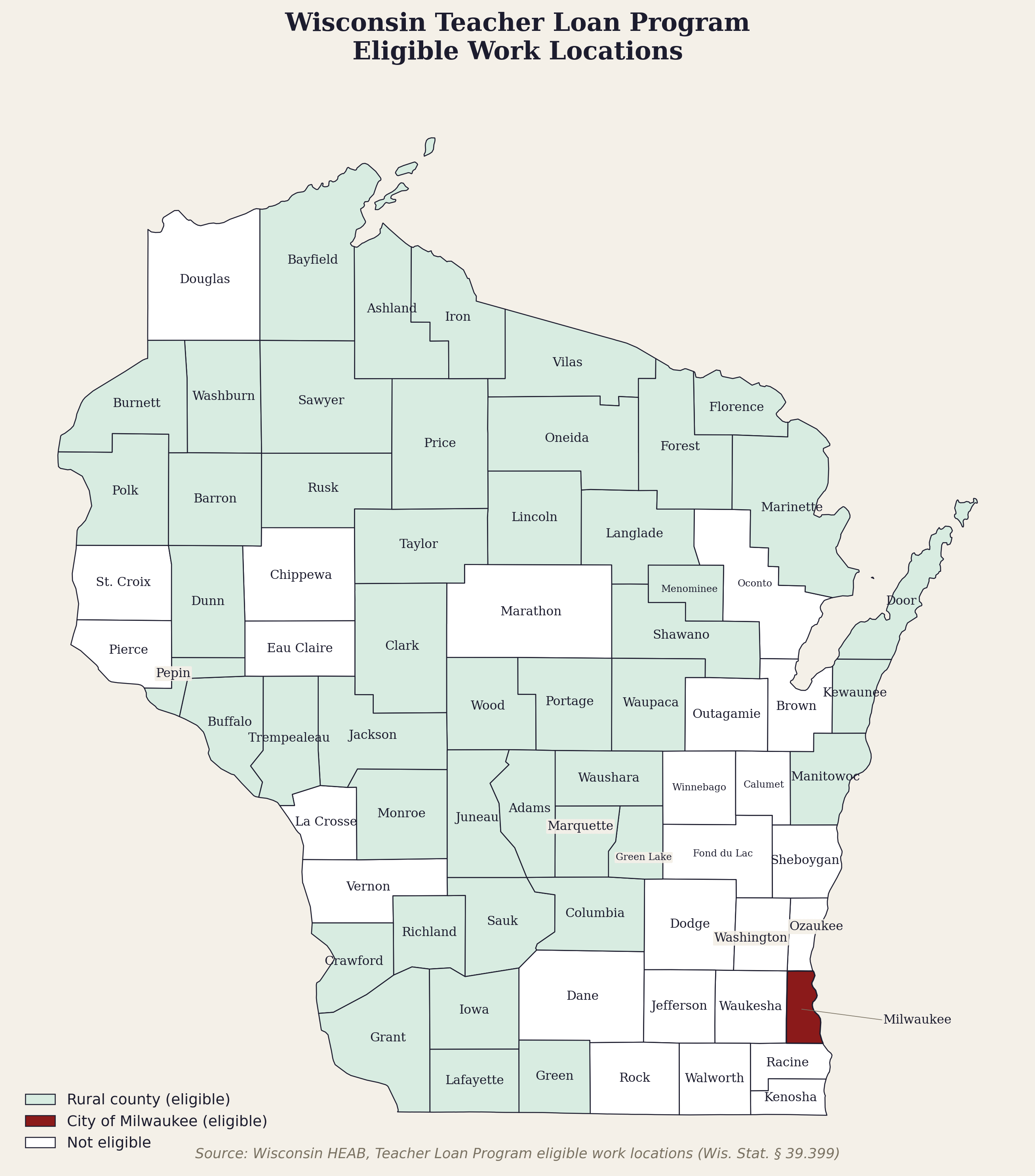
The current list of rural counties is:
Adams, Ashland, Barron, Bayfield, Buffalo, Burnett, Clark, Columbia, Crawford, Door, Dunn, Florence, Forest, Grant, Green, Green Lake, Iowa, Iron, Jackson, Juneau, Kewaunee, Lafayette, Langlade, Lincoln, Manitowoc, Marinette, Marquette, Menominee, Monroe, Oneida, Pepin, Polk, Portage, Price, Richland, Rusk, Sauk, Sawyer, Shawano, Taylor, Trempealeau, Vilas, Washburn, Waupaca, Waushara, Wood
If you meet all the criteria, 25% of your loan will be forgiven for each year you teach in an eligible location. Thus, meeting the criteria for four years will result in forgiveness of the entire TLP loan. If you don’t meet the criteria in a given year, that portion gets repaid instead, at 5% interest.
For folks who are already planning to teach in Milwaukee or one of the “rural” districts, TLP is close to free money. However, if you’re not sure where you’ll end up teaching, it’s probably worth thinking through before you take the loan. That said, the current federal Direct Loan rate for undergraduates is 6.52% so TLP’s 5% fallback rate is meaningfully better than federal loans. That doesn’t mean it is automatically better than every private option, which depends on your credit, but for an undergrad without established credit, I think TLP's worst-case 5% is probably better than anything they'd qualify for privately.
If the mention of loan forgiveness jogs a memory of programs like Teacher Loan Forgiveness or Public Service Loan Forgiveness, you should know that TLP is a different animal, both in how it operates (state level), how quickly it forgives loans (as fast as four years), and in the fact that it puts money in your hands while you’re still in school rather than forgiving a loan you’ve already been repaying. I plan to discuss federal loan forgiveness options in a future post.
How to Apply
TLP doesn’t have an application you fill out yourself, but you do need to file the FAFSA, since HEAB uses it to help confirm eligibility. Beyond that, the process runs through your school:
Tell your financial aid office you’re interested. Applicants apply through the financial aid office at a participating Wisconsin institution, not directly through HEAB.
Your financial aid administrator designates you, based on the eligibility criteria above, and offers you the loan.
The school submits your paperwork to HEAB. Once HEAB receives and approves the completed documents, the loan is disbursed directly to your school, not to you personally.
You repeat the process each year you want to draw on the loan again, up to the $30,000 lifetime cap.
One thing to note, funding is limited. So, being eligible and applying doesn’t guarantee a loan is available. I’d wager that the earlier you talk to your financial aid office, the better you’ll be.
Not every Wisconsin school participates. As of the current list, that includes UW-Green Bay, La Crosse, Milwaukee, Parkside, Platteville, River Falls, Stevens Point, Stout, and Superior, along with Alverno College, Carroll University, Concordia University, Edgewood College, Lakeland College, Maranatha Baptist University, Marian University, Marquette University, Ripon College, St. Norbert College, and Viterbo University. If your school isn’t on that list, check directly with HEAB, since this list can change.
I’m hoping this post is helpful for current students seeking assistance as well as all my colleagues who work with students. TLP is a wonderful opportunity that all should be more broadly shared across our programs.
This post is for educational purposes only. Information is current as of September 2026. Program terms and eligibility can change, so confirm current details directly with HEAB before making decisions based on this post. If you have questions or topic ideas, reach out at josh@personalfinanceforeducators.com.