
This post is part of the Path Series. If you’re new to Pip’s story, start with Pension at 55: A Starting Point, which lays out the foundation for this discussion.
In the last post about Pip, I explored one possible path to retiring at 55 using the Wisconsin Retirement System (WRS). This is not the only path, and it won’t be the right fit for everyone — but I think it’s worth understanding what this path can actually look like. Using the WRS Benefits Calculator, I found that with accelerated payments, Pip can retire at 55 with a consistent monthly income of roughly $3,550. That’s Pip’s floor on day one of retirement — and it stays consistent because the accelerated payment structure is designed to work together with Social Security at 62, smoothing income across that transition.
That $3,550 floor works out to about 71% of Pip’s pre-retirement gross salary of $5,000 per month. It’s a solid foundation. But what if Pip wanted to build above it? That’s where the Roth IRA comes in.

In this post I want to explore a simple question: what do modest, consistent Roth IRA contributions over a 32-year teaching career actually produce? Specifically, I want to look at five contribution levels — $100, $200, $300, $400, and $500 per month — and see how they change Pip’s retirement picture at 55.
A Note on Assumptions
Before diving in, a few things worth stating clearly:
I’m using the accelerated payments option from the previous post, with retirement at 55 as the goal. The accelerated payment structure is specifically designed so that when Social Security is added at 62, Pip’s total monthly income stays roughly consistent. In other words, $3,550 is Pip’s floor at 55, and it remains the floor after 62. This is one path. I’m hoping to explore other paths with future posts (e.g., regular payments, retiring at 57).
For Roth IRA growth, I’m using a 7.5% annual return. I generated these estimates using NerdWallet’s Roth IRA calculator, which you can access at https://www.nerdwallet.com/investing/calculators/roth-ira-calculator. I encourage you to plug in your own numbers and try out rates, annual contribution amounts, time horizon, etc. A 7.5% return is a reasonable long-term assumption for a broadly diversified index fund, but returns are never guaranteed.
For withdrawals, I’m using a 4.7% annual withdrawal rate. You may have heard of the 4% rule, a figure comes from researcher Bill Bengen’s original work in the 1990s. Bengen has since updated his research and suggests 4.7% is a more accurate figure (read about it in his new book!) I’ll use 4.7% here, but either way the point is the same: a reasonable, sustainable withdrawal rate applied to whatever Pip has saved.
A note on the contribution tiers: $100–$300 per month represents what I think of as the realistic planning range for most early educators. It is meaningful and achievable. The $400 and $500 per month tiers are aspirational targets representing a longer-term goal as career and income grow, rather than a first-year expectation. I’ll discuss where this money might come from in the next post.
As always, I’m a mathematics educator, not a financial advisor. These are illustrations, not recommendations.
What Does Pip’s Roth IRA Look Like at 55?
Pip starts teaching at 23 and retires at 55 — 32 years of contributions. Here’s what those contributions grow to, and what they can generate monthly starting at retirement.
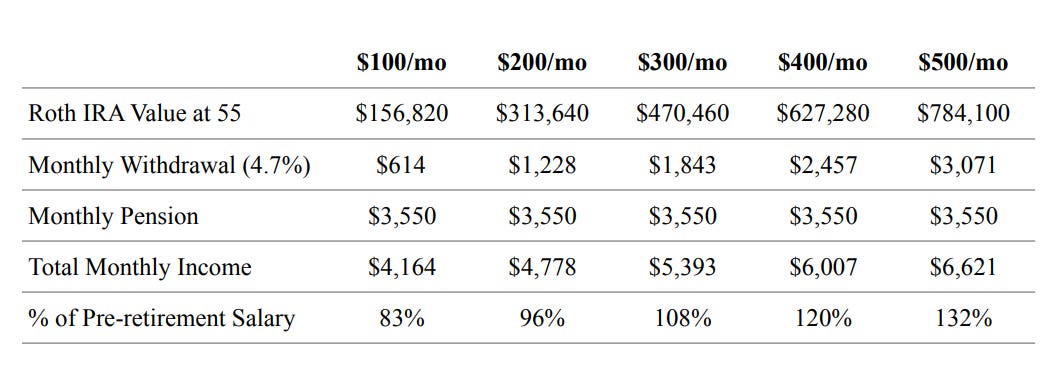
Note: monthly pension reflects the consistent monthly income Pip can expect from retirement at 55 onward, accounting for the accelerated payment structure and Social Security at 62. Roth IRA values generated using NerdWallet’s Roth IRA calculator at 7.5% annual return.
What Do These Numbers Tell Us?
A few things stand out when I look at this table.
First, even the most conservative scenario is meaningful. At $100 per month, Pip adds $615 per month to their retirement income starting at age 55. That brings total monthly income to $4,165 — 83% of pre-retirement gross salary. For context, Pip’s take-home pay while working was likely closer to $3,800–$4,000 after taxes and pension contributions. In other words, even the smallest contribution scenario gets Pip close to — or at — full income replacement in retirement, starting at 55.
Second, you might notice there is a clear relationship between contribution and Roth IRA value. Each additional $100 per month in contributions adds approximately $156,820 to the Roth IRA at retirement, and roughly $613 per month in retirement income. This linearity makes the math intuitive: every $100/month commitment today translates to roughly $600/month in retirement income.
Third, I think the $200/month scenario is particularly compelling. At 96% of pre-retirement salary, Pip is essentially at full income replacement. For many teachers, I think $200 per month is a sweet spot — meaningful and achievable without requiring extraordinary effort.
Fourth, the $400 and $500 per month scenarios are worth knowing about for planning but not something to focus on if you have a long career path ahead. They represent what becomes possible as a career matures, income grows, and you find your groove in the teaching lifestyle.
A Note on Where the Money Comes From
When I look at these tables, a natural question arises: where does $100–$300 per month actually come from on a teacher’s salary?
One answer people often reach for is discretionary spending. Just eat at fewer restaurants, reduce a subscription, skip the latte. I understand the impulse, but I think this framing is misguided for two reasons.
First, it can come off as dismissive of the small things that make daily life sustainable. If that $5 coffee helps you feel grounded and ready for everything the classroom demands, it’s not a frivolous expense — it’s self-care. Telling teachers to cut it out misses the point.
Second, and more importantly, I think there’s a better way to think about this — one that fits more naturally with the teaching lifestyle. Teaching is a profession with built-in opportunities to generate additional income that don’t require a second job, a new employer, or monthly discipline to execute. The path to $100–$300 per month doesn’t have to mean sacrifice. It may simply mean connecting an opportunity that’s already there to a goal that matters. I’ll explore this in the next post.
The Bigger Picture
What I want readers to take away is how the pieces of this path fit together. The pension provides a guaranteed floor — income that arrives every month at 55, regardless of market conditions, and stays consistent as Social Security fills in later. Both have provisions that can adjust with inflation over time. The Roth IRA builds above that floor from day one of retirement, providing flexible, tax-free income that Pip controls completely.
Together, they create a retirement picture that is both stable and adaptable. The pension tells you what your floor is. The Roth IRA determines how high above that floor you can go.
There is also a psychological dimension worth noting. Knowing that you have a Roth IRA growing alongside your pension changes how you feel about your financial stability. It gives you peace of mind when sudden shifts happen (e.g., illness, losing a job). It also gives you options for how you spend in retirement. Maybe you draw from it heavily in your late 50s and early 60s (your go-go years). Maybe you use it for a large purchase or a once-in-a-lifetime trip. Maybe you leave some of it to your family. The floor is there either way. The Roth is what gives you room.
As I noted, this is one path among many. In future posts I’ll explore what happens if Pip uses regular payments instead of accelerated, waits until 57 to retire, or adjusts their contribution rate over time. Each path tells a different story and serves a different set of goals.
For now, the takeaway is simple: $100 a month, started early, makes a meaningful difference at 55. And in the next post, I’ll make the case that teaching already gives you a natural way to find it. Extra duties, club advising, mentoring stipends, covering classes — these are already part of the landscape of the profession, and they pay real money.
If you enjoyed this post, please share it with a friend! As always, I’m a mathematics educator, not a financial advisor. This post is for educational purposes only. If you have questions or topic ideas, reach out at personalfinanceforeducators@gmail.com.