

A few years ago, I had the opportunity to teach a first-year seminar course at UW-La Crosse. The course content was a mix of something I am passionate about (I picked board games) and a collection of common content that first-year students should know a bit about. One of the topics on the common content list was the scholarship opportunities available through the UWL Foundation. Rather than just discussing scholarships and having students identify a few, I wanted to provide some motivation for students to spend time preparing applications. It can be a challenge to get people to see what a scholarship application is actually worth when it feels like busy work for an unlikely outcome.
So we built a spreadsheet to make the value concrete. Spend 10 hours applying for a $1,000 scholarship and, if you are awarded it, you’ve earned $100 an hour. Since scholarship money used for tuition and fees generally isn’t taxed, that’s $100 an hour you get to keep. No part-time job that I am aware of comes anywhere close to that kind of time for dollars value.
Although I haven’t taught the course in a few years, the ideas behind the spreadsheet have continued to grow. I was recently asked to build a tool that students applying for scholarships can use in their work. Thus, the Scholarship Value Estimator came to life. This tool is for anyone who works with students and wants to encourage them to apply for scholarships — high school teachers, counselors, teacher educators, and support staff alike. Use it to show students the real financial value of applying, and to help them build a strategy for where to focus their time. It is the latest in my collection of free personal finance tools that run in your browser and don’t require an account. I’m going to unpack the tool a bit in this post, but if you want to look at it now, here’s the link.
The quick math
A quick way to think about what a scholarship is worth in terms of time is this: divide the award by your hourly wage. So, if you make $10 an hour, a $100 scholarship is worth 10 hours of work. If you make $20 an hour, a $100 scholarship is worth five hours of work.
That’s the quick math. The truth is that scholarships are probably worth more time than the calculation because income taxes reduce the hourly wage. For example, here’s a table with the approximate value of different scholarship amounts when compared to a $15 an hour wage with a 12% tax rate:
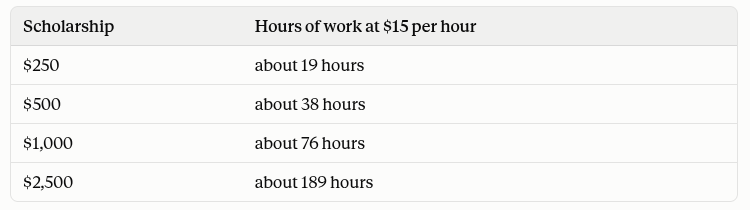
It’s true that you need to apply for a scholarship and that can take anywhere from a few to several hours. However, I think the math is pretty compelling when you consider that a $500 scholarship is equivalent to almost a full week of work at $15 an hour. Even a $250 scholarship is about two and a half days of work.
The tool itself has two tabs: the Value Estimator and the Portfolio Planner.
Tab 1: The Value Estimator
The Value Estimator is intended for high-level planning. You can set an overall target scholarship amount, hours spent applying, and expected success rate. Then you enter your estimated hourly wage and marginal tax rate (the share of your next dollar earned that goes to taxes). It then calculates the total amount you should apply for, effective hourly rate, and a few other statistics.
Here’s an example. Let’s say you aim for $2,000 in scholarships, are willing to spend 12 hours applying, and expect a 20% success rate. The tool calculates that you should apply for $10,000 in scholarships and would have an effective hourly rate of $133 if you were successful. Moreover, if you earned $18 an hour at your part-time job with a 12% tax rate, this would be equivalent to 126.3 hours of work.
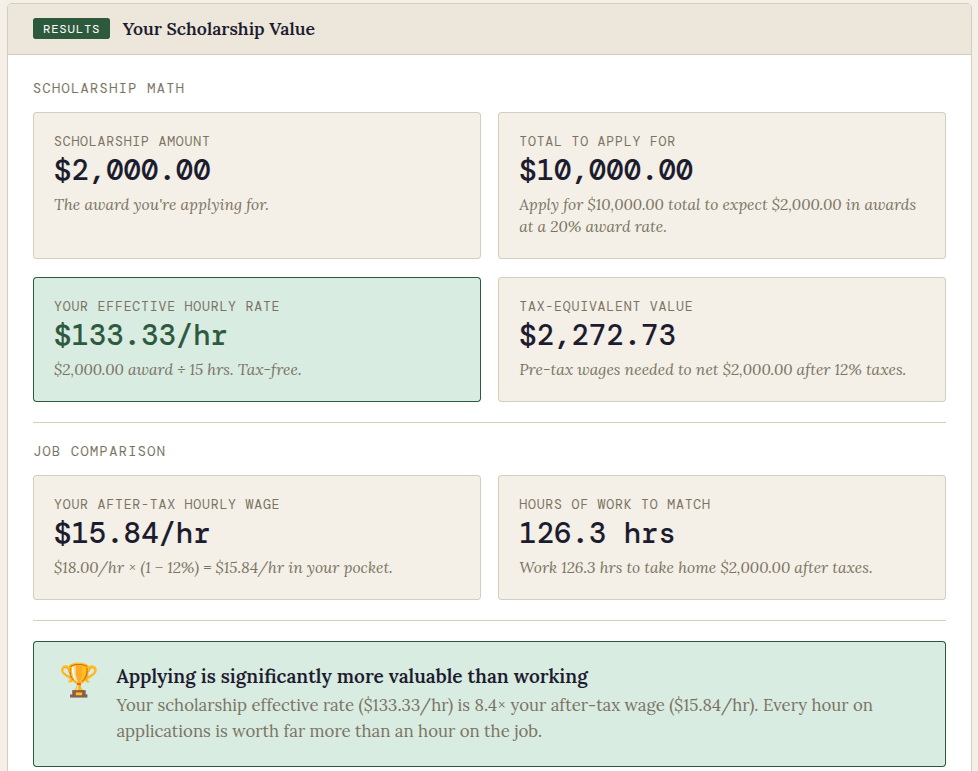
The success rate is the hardest number to estimate, so I included a drop-down reference with some estimates. Department or program-specific scholarships tend to have better odds than national competitions, often by a wide margin, because the applicant pool is much smaller.
Tab 2: The Portfolio Planner
For students who are ready to take the next step in planning, there is the Portfolio Planner. This tab lets you build a list: each scholarship you’re considering, its amount, how long you expect it to take, and your odds. The tool will also carry your wage and tax rate over from the first tab if you input them (you can still change them). The output shows:
Your expected total awarded scholarship amount
Total hours across all applications
A blended hourly rate for the whole plan
A breakdown showing which scholarships are pulling their weight and which aren’t
This is where the tool becomes more useful for planning. A quick departmental application with a modest award can easily outperform a large national scholarship that takes many hours and has a small chance of being successful.
A few things to keep in mind
Honesty is the best policy when using this tool, as the results are only as good as the estimates you put in. Be honest about how long applications actually take you and the likelihood of success.
Also, keep in mind that to be tax-free, the scholarship money needs to pay for tuition, required fees, and required books and supplies. Money used for room and board, or scholarships that require you to work in exchange, are taxable. If your scholarships exceed your tuition and fees, or you’re not sure how yours is treated, IRS Publication 970 covers the details. And if your income is low enough that you owe little or no federal income tax, your marginal rate may be close to 0%, which shrinks the gap between scholarship money and wages.
Finally, money is just one of the benefits of a scholarship. Being an awardee can also mean recognition, a line on a résumé, or a connection to a department or organization. Although these benefits are hard to quantify, they can also have a big impact.
If you work with college students, including future teachers, feel free to share the tool. And if you use it and have ideas for improving it, I’d like to hear them: josh@personalfinanceforeducators.com
Try the tool: Scholarship Value Estimator
~Josh
New here? The New Here page has a short reading list to help you get oriented.
This post is for educational purposes only and is not individual financial advice. If you have questions or topic ideas, reach out at josh@personalfinanceforeducators.com.