

This post is part of the Path Series. If you’re new to the series, start with Pension at 55: A Starting Point, and then read The Roth IRA: Building on the Pension Floor, which provides the foundation for this discussion.

August brings a different kind of weight than June. The path up the mountain stretches far ahead. The question is whether you go into the climb with a plan.
My goal with this post is to offer one specific objective that I think most teachers can accomplish: making regular contributions to a Roth IRA. At the end of my last post in this series, I discussed how a modest contribution could allow someone to retire at 55 with full income replacement. But I left an important question open: where does the money actually come from?
I’m going to refuse to the obvious answer, which is extra work during summer. I’m not arguing that summer work isn’t feasible, but I view summer break as one of the genuine structural benefits of the profession. As I’ve discussed previously, that time has real value. A young educator in their 20s might see extra income as a worthwhile trade. But I think many folks eventually reach a point where total control of time becomes more valuable than the income that could be earned with it. Thus, I don’t want to make contributions to a Roth dependent on summer’s expense.
With summer off the table, that leaves the school year. I’m going to set a specific goal: an extra $2,400 a year, funded entirely by duties already built into the job. On a 10-month teaching calendar, $2,400 works out to $240 a month. As I discussed in the last post, this is likely enough to bring Pip close to full income replacement at age 55.
Set a contribution target. Find a way to reach it during the school year. That’s the game plan.
What Extra Duties Actually Pay
In most districts, there are a variety of opportunities to earn additional income by taking on responsibilities. They range in time commitment and duration. In addition to the income, some of these roles are genuinely rewarding ways to engage with students and the broader school community. For some folks, the relational benefits are at least as valuable as the monetary ones. Based on my own analysis of handbooks from districts across Wisconsin, here’s a rough picture:
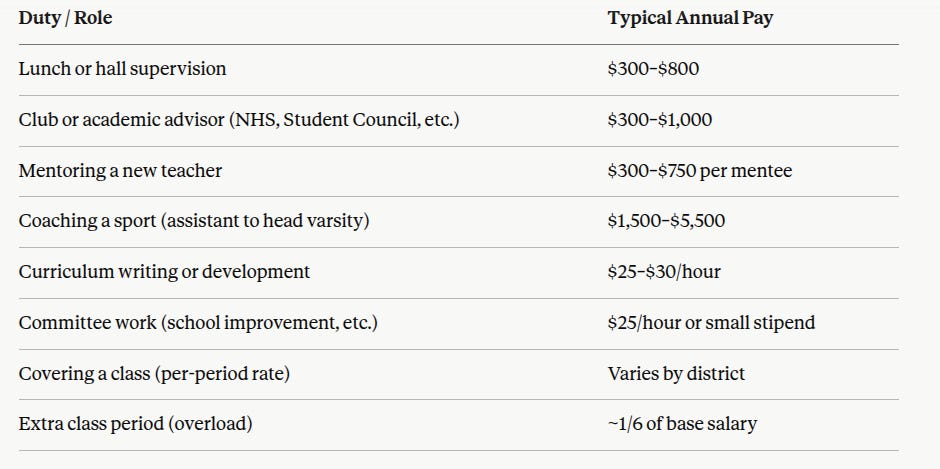
These numbers vary by district and should be spelled out in your employee handbook or a supplemental compensation document.
Three Ways to Reach $2,400
The same target can be assembled from very different building blocks, depending on your interests, schedule, and stage of career.
Option 1: A single big commitment. One role does most of the work. In the Verona Area School District, for example, a JV coach or 7th/8th grade coach earns $2,335 — close enough to our target that one small additional duty bridges the gap. A head coaching stipend for sports like cross country, volleyball, or soccer pays $3,498, clearing the target on its own. The Fall Musical Director or Spring Play Director earns $2,916, which also clears it. The right choice depends on your interests, schedule, and energy. Some roles carry significantly more time commitment than others. That’s not a reason to rule them out, but it’s a reason to think carefully about whether the role fits your season of life.
One additional option worth mentioning: teaching an overload section. A single semester overload would exceed the target on its own, and two semesters would clear it comfortably. That said, an overload is a significant commitment and not something I’d recommend to anyone in their first few years.
Option 2: Combining several medium commitments. A club advisor role in the $800–$1,000 range, plus a mentoring stipend for one new teacher ($500–$750), plus a semester of lunch supervision ($400–$600). Three modest commitments, none of them dominating your week, adding up to the target. You can make these choices seasonal so they don’t overlap, spread them out for consistent income across the year, or stack them if your schedule allows.
Option 3: Steady accumulation. Several small duties done consistently — occasional class coverage, a smaller club, a committee or two. This suits someone who would rather spread the load across low-intensity tasks than commit to one larger role. The key with this approach is consistency: you’ll need to track your income across duties to make sure you’re hitting the goal.
Reframing Your Work: What Are You Actually Deciding?
A central point I’m trying to make here — beyond showing that the math is feasible — is that thinking in terms of goals is a useful way to shift your perspective.
Instead of asking: Is this duty worth the extra time? you can ask: How does this duty help me reach my Roth IRA goal?
If you pre-commit that money to your Roth IRA and set up automatic contributions from your bank account, you’re building a system rather than relying on monthly discipline. The money never lands in your checking account. It never gets absorbed into everyday spending. It never requires you to remember.
One decision. One routing. Many years of compounding.
A Note of Caution
Teaching is demanding, and time and energy are finite. I’m not arguing that every teacher should pile on extra duties. Early-career teachers in particular often need to protect their bandwidth while building the craft — and protecting summer is part of that same instinct.
My point is narrower: if you were already considering a duty, or one is available that fits your interests and schedule, the financial case for routing that income to a Roth IRA is strong. The club advisor role, the mentoring, the covered class: these come and go with the school year. What has the potential to stay is the money you earn and its interest.
The Bigger Picture
In earlier posts I’ve described the pension as a kind of floor: a guaranteed income that arrives every month regardless of the market. I showed that at 7.5% returns over 32 years, $100 a month grows to about $156,820 and produces roughly $615 a month in retirement income at a 4.7% withdrawal rate. The full $2,400/year target scales to roughly $376,000 in the Roth and about $1,476 a month in retirement income, on top of the pension and Social Security floor. These are projections based on standard compound growth assumptions. The market determines how accurate they turn out to be.
Extra duties aren’t the only way to fund a Roth. But they’re one of the cleanest paths available to teachers, precisely because they’re already embedded in the structure of the job and don’t cost you your summer. The opportunities are already there. The only question is whether you connect them to a goal or let the income disperse into the ether of everyday life.
Feel free to ignore this choice — it’s your time. A modified version where you work summers early in your career and ease off later could put you in a stronger financial position, since contributions made in your 20s have more time to compound. But I would think carefully before converting your mini-sabbaticals into a steady income stream.
As always, I’m a mathematics educator, not a financial advisor. This post is for educational purposes only. If you have questions or topic ideas, reach out at josh@personalfinanceforeducators.com.